
If you run a small business in California, you already juggle permits, payroll, inventory, and a long list of rules most owners in other states never think about. Accessibility belongs near the top of that list. California sees more disability access lawsuits than any other state, and the targets aren’t just big-box retailers. Neighborhood cafés, nail salons, dental offices, and auto shops get served every week.
The good news is that most access barriers are physical, measurable, and fixable. You don’t need to be an architect to spot the obvious ones. This checklist walks you through the areas that generate the most claims, explains why each one matters, and shows you where a professional review fits in.
Why California Small Businesses Face Higher Risk
Two sets of rules apply to most California businesses. The federal Americans with Disabilities Act sets the national baseline, and the California Building Code (Chapter 11B) adds its own requirements, which are stricter in many places. On top of that, the state’s Unruh Civil Rights Act allows a plaintiff to recover a minimum of $4,000 in statutory damages for each occasion they encountered a violation, plus attorney fees. Federal law alone doesn’t offer money damages to private plaintiffs, which is why so many access cases are filed in California.
That combination means a single visit can turn a slightly steep parking space or a heavy door into a five-figure problem once legal fees are added. Fixing barriers early is almost always cheaper than defending a claim.
The Checklist: Area by Area
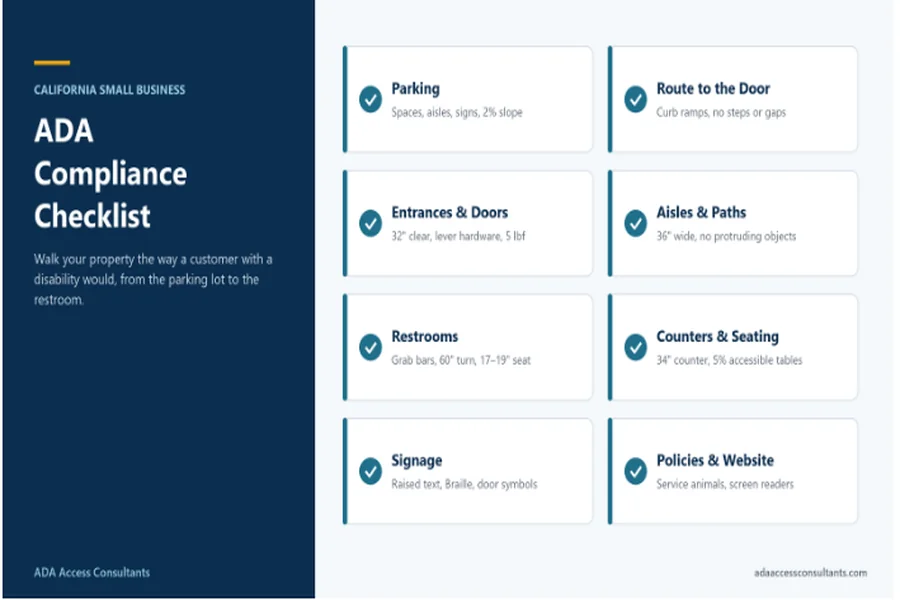
Walk your property the way a customer using a wheelchair, a walker, or a white cane would. Start in the parking lot and finish in the restroom. Here’s what to look at along the way.
1. Parking
- Do you have the required number of accessible spaces for the size of your lot, including at least one van-accessible space?
- Is each accessible space and its access aisle clearly striped, with the aisle marked “NO PARKING” as California requires?
- Is there a posted accessible-parking sign at each space, plus the tow-away warning sign California requires at lot entrances?
- Is the parking surface and the access aisle close to level (no more than a 2% slope in any direction)?
2. The Route to Your Front Door
- Is there an accessible route from the parking spaces and the public sidewalk to your entrance?
- Are curb ramps present where the route crosses a curb, and are they in good repair?
- Is the route free of steps, abrupt changes in level, gaps, and loose gravel?
3. Entrances and Doors
- Does the entrance door provide at least 32 inches of clear width when open 90 degrees?
- Is the door hardware usable without tight grasping or twisting? Lever handles and push bars work; round knobs don’t.
- Can the door be opened with no more than 5 pounds of force (interior doors), and does the threshold stay at or under 1/2 inch?
- Is there level maneuvering space on both sides of the door?
4. Aisles and Interior Paths
- Are aisles and routes through the space at least 36 inches wide, even after seasonal displays go up?
- Are there wall-mounted objects (shelves, fire extinguishers, signs) sticking out more than 4 inches into a walkway between 27 and 80 inches above the floor?
5. Restrooms
- Is there an accessible restroom (or accessible stall) with a 60-inch turning space?
- Are the side and rear grab bars installed at 33 to 36 inches high and long enough?
- Is the toilet seat 17 to 19 inches high, and are the soap, towels, and mirror within reach?
- Are the pipes under the lavatory insulated or covered so a seated user doesn’t get burned?
6. Counters, Seating, and Controls
- Does your sales or service counter have a section no higher than 34 inches (California) and at least 36 inches long?
- If you offer seating or dining, are at least 5% of the tables accessible, with proper knee clearance?
- Are card readers, light switches, and other controls you expect customers to use within reach?
7. Signage
- Do permanent room signs, especially restroom signs, include raised characters and Braille, mounted at the right height on the latch side of the door?
- Does California-required restroom door geometric signage (circle for women, triangle for men) appear on the door itself?
8. Policies and Your Website
- Do your staff know that service animals must be allowed, and which two questions they may legally ask?
- Is your website usable with a screen reader and keyboard? Website accessibility claims are now a large share of ADA filings.
- If you lease your space, did your landlord disclose whether the property has had a CASp inspection? California Civil Code Section 1938 requires commercial landlords to say so in the lease.
What a Self-Check Can (and Can’t) Do
A checklist helps you catch obvious problems, like a missing sign or a blocked aisle. What it can’t do is measure the 2.4% slope in an access aisle or the 6.2 pounds of force on your restroom door. Those small numbers are exactly what plaintiffs’ consultants measure. The federal technical rules are spelled out in the Department of Justice’s ADA Update: A Primer for Small Business, which is a good free read, but California’s code adds requirements you won’t find there.
That’s where a Certified Access Specialist (CASp) comes in. A CASp is a professional certified by the state to inspect properties against both federal and California standards. Working with an experienced California CASp inspection firm gets you a written report with measurements, photos, code citations, and a prioritized list of fixes. It also unlocks real legal protection: a business with a CASp report on file before a lawsuit can request a 90-day stay and an early evaluation conference, and it may qualify for reduced minimum damages if it fixes the listed items on time.
How to Pay for Accessibility Fixes
Barrier removal doesn’t have to come entirely out of pocket. Federal tax law offers two incentives worth discussing with your accountant:
- Disabled Access Credit (IRS Form 8826). Eligible small businesses (up to $1 million in revenue or 30 full-time employees) can claim a credit of 50% of eligible access spending between $250 and $10,250 per year, for a maximum credit of $5,000.
- Architectural Barrier Removal Deduction (Section 190). Any business can deduct up to $15,000 per year for qualified barrier removal costs.
The IRS explains both on its tax benefits for businesses page. Many owners spread fixes over two or three tax years so they can claim the credit each year.
Put the Checklist to Work
Start with the items that are cheapest and most visible: signage, striping, door hardware, and restroom accessories. Then plan the bigger items, such as regrading a parking area or rebuilding a restroom, with a contractor who understands accessibility. Keep receipts and photos of everything you fix. If a claim ever arrives, that paper trail shows good faith.
If you’d rather know exactly where you stand, a CASp inspection from ADA Access Consultants turns this checklist into a measured, code-referenced plan you can act on, with no guesswork about which items carry the most legal risk.
Frequently Asked Questions
Does the ADA apply to my small business?
If your business is open to the public, Title III of the ADA almost certainly applies, regardless of size. There’s no small-business exemption from accessibility, although the cost of barrier removal in an existing building is weighed against what’s readily achievable for your business.
Is there a grandfather clause for older buildings?
Not really. Older buildings must still remove barriers when it’s readily achievable. Elements that met the 1991 standards and haven’t been altered may get safe-harbor treatment under federal law, but California’s rules and the Unruh Act create additional exposure.
How much does a CASp inspection cost for a small business?
Pricing depends on the size and complexity of the property. A small storefront typically costs far less than a multi-tenant center, and the cost is usually a fraction of what a single lawsuit settlement runs.
Do I need a CASp inspection if I lease my space?
Tenants and landlords can both be named in a lawsuit. Even if your landlord handles common areas, your interior, restroom, and counters are usually your responsibility, so an inspection of your space is worth it.